Description
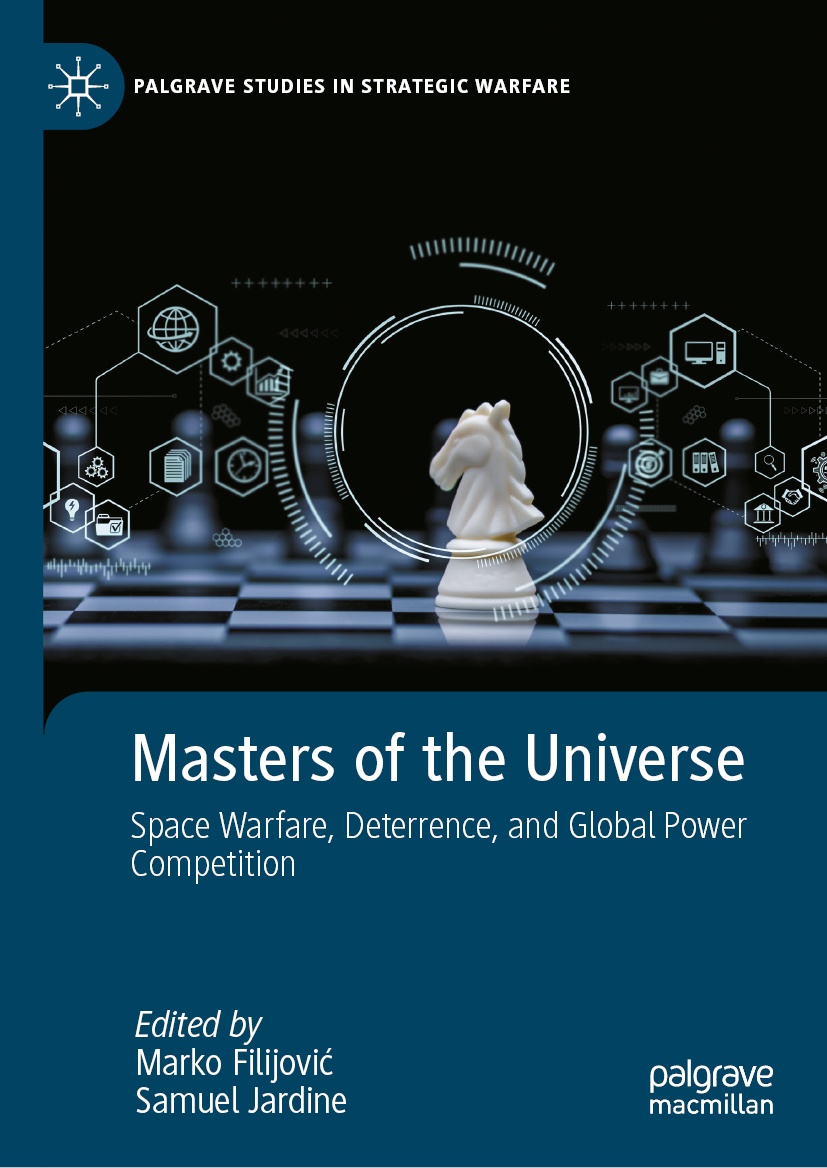
Masters of the Universe
Space Warfare, Deterrence, and Global Power Competition
Filijović, Marko (Ed. / Hrsg.); Jardine, Samuel (Ed. / Hrsg.)
ISBN 978-981-92-3028-0 · Palgrave Macmillan · XX, 398 p. ·
Description / Beschreibung
This edited volume offers a pioneering and multidimensional analysis of the evolving geopolitics, strategic rivalries, and legal frameworks that define outer space in the 21st century. It positions space not merely as a scientific or technological frontier but as a contested domain at the nexus of peace and war, fundamental to the security, economy, and strategic behavior of states.
Through comparative case studies and theoretical innovation, the book examines how major and emerging powers such as the United States, China, Russia, the EU, India, and Japan are competing for influence beyond Earth’s atmosphere. It explores how outdated governance mechanisms, the militarisation of orbital and lunar spaces, and the growing entanglement of commercial and military interests are reshaping global order. By integrating strategic studies, international relations, space law, and regional security, this interdisciplinary volume lays the groundwork for a geopolitical approach to power in the Solar System.
Structured around national and regional analyses, the chapters investigate critical issues such as deterrence, escalation control, sovereignty, and the future of arms control in space. They also assess emerging governance initiatives, commercial ventures, and technological developments from anti-satellite weapons to cislunar operations, highlighting their implications for conflict prevention and cooperation.
Offering both theoretical depth and empirical insight, the book fills a crucial gap in current scholarship by treating outer space as a central arena of strategic competition. Anticipating future developments, the book explores potential scenarios such as the weaponization of space, the risk of Kessler Syndrome, and the strategic implications of Moon and Mars colonization.
This forward-looking analysis equips policymakers and scholars with critical insights into the evolving nature of warfare and the imperative for adaptive strategies in the space domain. It is both timely and vital to contemporary debates on the future of warfare, diplomacy, and global security in the space age.
Contents / Inhaltsverzeichnis
1. Introduction: Space Warfare, Deterrence, and Global Power Competition.- Section I: Rethinking space as a strategic domain.- 2. Geopolitics of the Solar System.- 3. The Moon as Laboratory, Gateway, and Mirror: Power, Governance, and the Endurance Advantage.- 4. The Ultimate High Ground: Orbital Control as the Foundation of Next-Gen Warfare.- Section II: Actors and strategies in the contemporary space order.- 5. Strategy for the Infinite Frontier: The US Approach to Spacepower in the 21st Century.- 6. Plausible Deniability in Orbit: Russia’s Art of Legal Evasion in Outer Space.- 7. China’s Strategy for Space Global Governance: More Expected Achievements and Duties.- 8. India in the Global Space Order: Technology, Policy, and Security.- 9. European Strategic Autonomy in Outer Space: Governance, Capabilities and the Emerging Architecture of Space Power.- 10. Hybrid Ambitions: The Civil–Military Nexus of Spacepower in the Arab Gulf and Iran.- 11. African Space Strategies and Policies in a Polarised Geopolitical Environment.- 12. Latin America in the New Space Race.- 13. Complementary Middle Powers in Orbit: The United Kingdom, Canada, and Australia in Space Governance and Deterrence.- 14. Normative Gravity: Japan’s Middle Power Strategy in the New Space Order.- Section III: Governance, law, and future space order.- 15. Not Another Wild West: Governing Celestial Bodies – Peacefully, Safely, and Sustainably.- 16. Conclusion: Power, Governance, and the Expanding Scope of Geopolitics.
Contributors / Mitwirkende
Marko Filijović, PhD, is a geopolitical and security expert specialising in extraterrestrial geopolitics, governance, and outer space resources, alongside Arctic dynamics and global security. He currently serves as a Geopolitical and Special Advisor at Riley Risk Inc. and consults for private sector clients including Valinor Intelligence Ltd. and London Politica.
Marko has extensive experience in geopolitical risk analysis, strategic advisory, and policy research, working with international organisations, private sector clients, and academic institutions. He holds a PhD in Security Studies from the University of Belgrade and has authored over 70 academic publications.
Samuel Jardine is a geopolitical consultant and historian specialising in strategic competition, governance, grand strategy, and risk management, focusing particularly on space, the Arctic, the Antarctic, and the seabed. He is currently the Head of Research at London Politica, a Senior Policy Lead at the Open Lunar Foundation, a Research Associate for Oxford University and CHACR’s Climate Change & (In)Security Project and a Policy Specialist for the Lunar Policy Platform. Formally, Sam was the Project Manager for Lord Kerslake’s independent cross-bench Commission for UK Military Accommodation and was a Consultant for the Royal United Services Institute’s (RUSI). Sam holds an MA in Modern History from King’s College London, a BA(Hons) in History from the Open University and was a RUSI Military Sciences “Rising Stars” mentee.
Features / Besonderheiten
Explores the militarization of space, orbital control, and the geopolitical significance of celestial bodies Offers a comparative examination of the space strategies of USA, China, Russia, India, Japan, the EU, UAE & Brazil Examines evolving space law and governance to address legal gaps, civil-military fusion, and strategic competition