Description
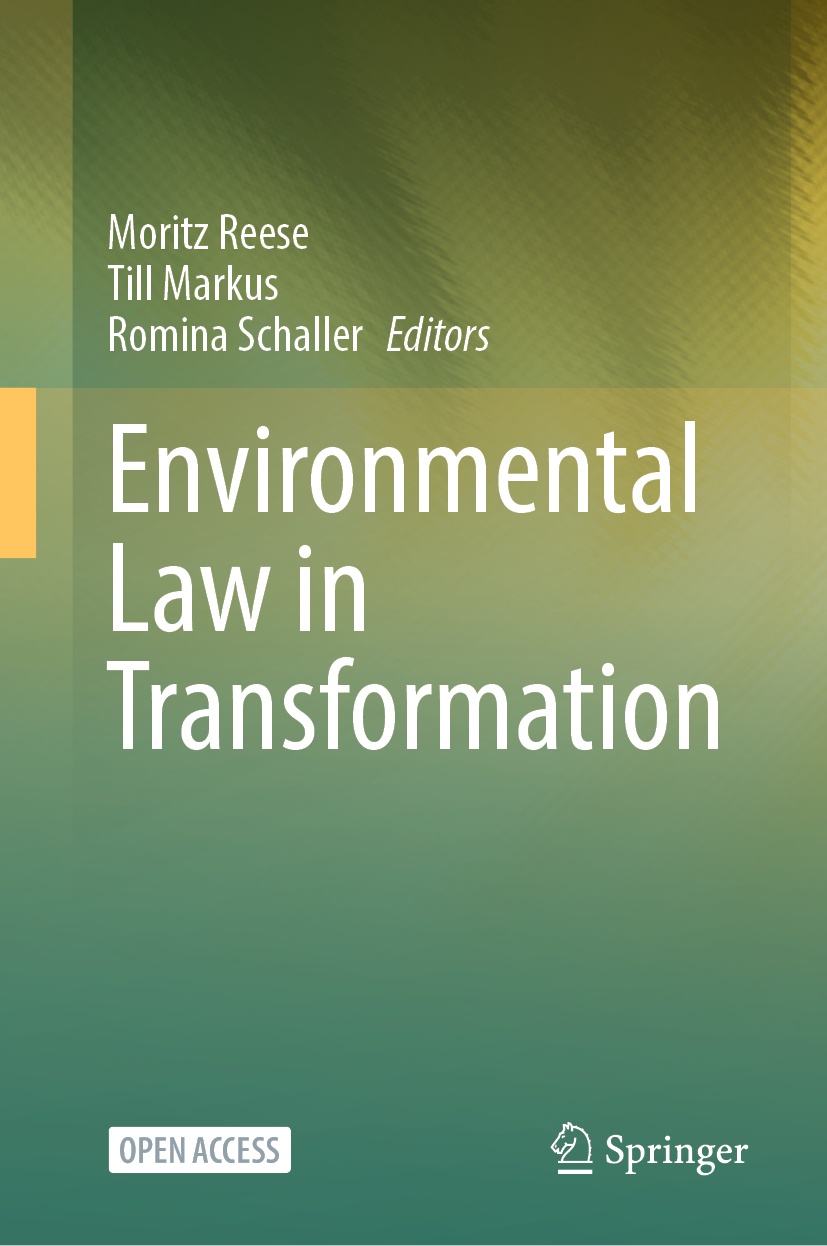
Environmental Law in Transformation
Reese, Moritz (Ed. / Hrsg.); Markus, Till (Ed. / Hrsg.); Schaller, Romina (Ed. / Hrsg.)
ISBN 978-3-032-31566-3 · Springer · X, 250 p. 1 illus. ·
Description / Beschreibung
This open access book examines the changing role of environmental law as it evolves from a framework primarily concerned with limiting environmental harm into an instrument for actively shaping the ecological transformation of society. Environmental law is increasingly expected to steer long-term change across energy systems, land use, and entire economic sectors. Environmental Law in Transformation provides a systematic analysis of this emerging legal paradigm and the governance challenges it raises.
Drawing on the European Green Deal and landmark legislation such as the EU Climate Law and the Nature Restoration Law, this volume explores how environmental law is developing into a formative instrument for societal transformation. Leading German scholars examine the fundamental tensions of transformative governance: How can law commit to long-term objectives under conditions of deep uncertainty? How can environmental law reconcile precaution with the need to promote innovation? And to what extent can planning-oriented legal instruments shift political power from the legislature to the executive?
Covering planetary boundaries and constitutional law, legal drivers for sustainable innovations, multifunctional land use, and knowledge obligations in environmental quality management, the contributions combine critical analysis of current developments with forward-looking perspectives on the future of environmental law.
The volume will be of particular interest to legal scholars, environmental practitioners, and policymakers seeking to understand the changing role of law in shaping the ecological transformation of society in the 21st century.
Contents / Inhaltsverzeichnis
Part I Environmental Law and Precaution in the Anthropocene.- Fundamental Legal Issues in the Anthropocene.- Planetary Boundaries and Constitutional Law: Towards Environmental Sustainability by Enforcing the Precautionary Principle.- The Precautionary Principle in Selected Areas: Status and Development Prospects for Re-source Oriented Precaution.- Part II A Legal Framework for Sustainable Innovation.- The Precautionary Principle and Innovation.- Legal Drivers for Sustainable Innovations Michael von Landenberg-Roberg.- Part III A New Area of Environmental Planning (Law) for Transformation.- Planning law as an instrument for ecological transformation.- Targets and measures: How to build climate change law?.- EU policy planning law for the implementation of the Green Deal.- Multifunctional Land Use as a Key Concept in Planning Law.- Thou shalt not ignore – knowledge-obligations as a fragile implementation incentive in the law of environmental quality management.
Contributors / Mitwirkende
Prof. Dr. Moritz Reese is Head of the Department of Environmental and Planning Law at the Helmholtz Centre for Environmental Research – UFZ and Professor of European Environmental Law at the Faculty of Law of Leipzig University. His research focuses on European and national environmental law, particularly water law, circular economy law, climate adaptation, nature conservation, and sustainable urban and infrastructure planning; he also serves as Chair of the European Environmental Law Forum (EELF) and co-editor of leading environmental law journals.
PD Dr. Till Markus, LL.M., is Deputy Head of the Department of Environmental and Planning Law at the Helmholtz Centre for Environmental Research – UFZ and a Privatdozent at the Faculty of Law of the University of Bremen. His research and teaching focus on international, European, and comparative environmental law, with particular emphasis on climate, energy, marine and biodiversity law, as well as legal theory.
Dr. Romina Schaller is a Postdoctoral Researcher in the Department of Environmental and Planning Law at the Helmholtz Centre for Environmental Research – UFZ, where she also coordinates the Competence Network Challenges of Environmental Law (KomUR). Her research focuses on international and European environmental law, particularly climate change mitigation, ecosystem services, sustainable development, and the governance of carbon dioxide removal technologies (CDR).
Features / Besonderheiten
This book is open access, which means that you have free and unlimited access Reveals how environmental law is evolving into long-term, policy-driven governance in Germany and the EU Offers cutting-edge analysis of Green Deal laws driving climate and nature protection Delivers an integrated framework linking theory and practice for transformative planning law and innovation