Description
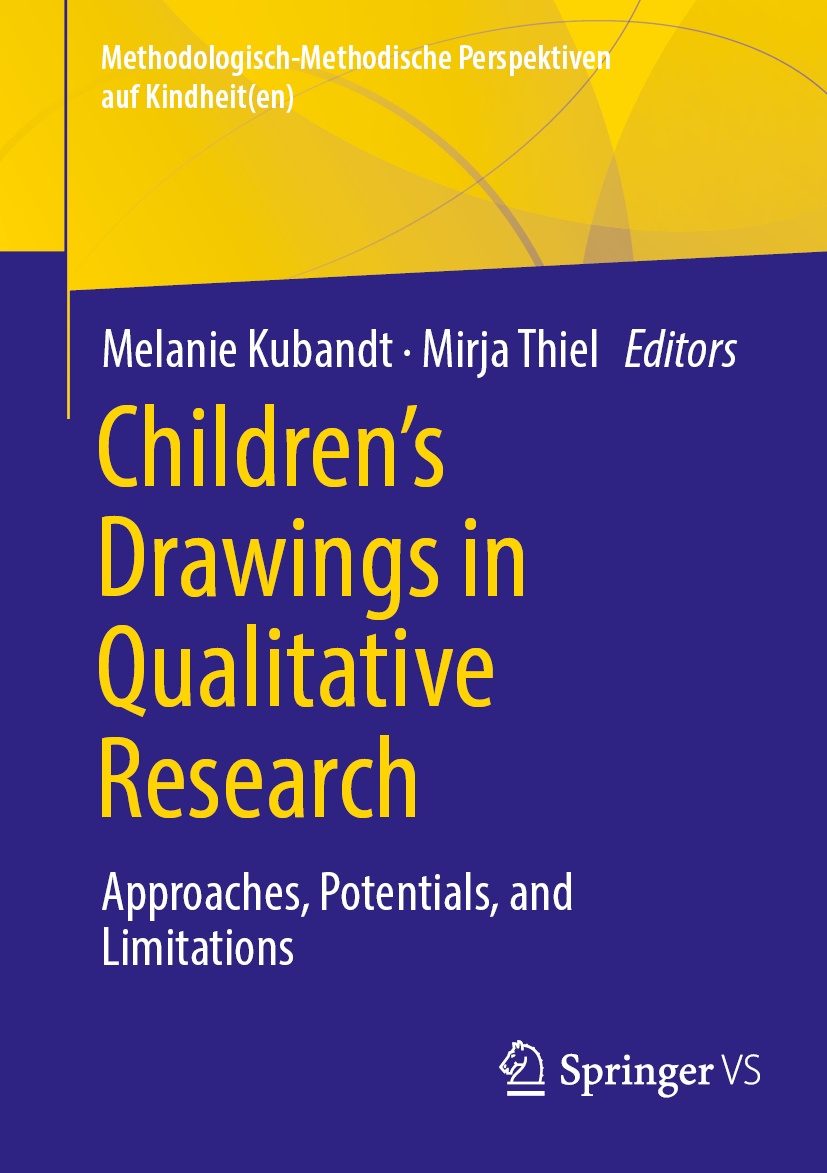
Children’s Drawings in Qualitative Research
Approaches, Potentials, and Limitations
Kubandt, Melanie (Ed. / Hrsg.); Thiel, Mirja (Ed. / Hrsg.)
ISBN 978-3-658-53126-3 · Springer · XVII, 341 p. 73 illus., 55 illus. in color. ·
Description / Beschreibung
The aim of this edited volume is to provide a more clearly defined understanding of children’s drawings within the context of qualitative research, to demonstrate the distinctive characteristics and autonomy of children’s drawings as a specific type of data, and to highlight their empirical value through exemplary research projects. In addition, the volume presents possible approaches to the analysis and interpretation of children’s drawings.
The book both systematizes a wide range of epistemological perspectives and provides an overview of diverse methodological approaches to children’s drawings. In doing so, it offers an interdisciplinary perspective on how and in which contexts—including educational science, the social sciences, childhood research, and subject-specific didactics—children’s drawings become objects of inquiry, as well as on the potentials and (epistemological) limitations associated with their use.
Contents / Inhaltsverzeichnis
Challenges and Limitations in the Analysis of Children’s Drawings: An Outline of the Problem from an Art Historical and Visual Methodological Perspective.- Nele and the Crocodile: Hermeneutic Image Analysis as a Method for Researching Children’s Drawing.- Visual Grounded Theory as a Method for Analyzing Children’s Drawings in Ethnographic Research – Potentials for Approaching Children’s Perspectives.- Interpreting Spatial Images: Visual Segment Analysis of Children’s Drawings.- Children’s Drawing Analysis as an Opportunity for Researching Educational Processes: An Objective-Hermeneutic Approach to Children’s Drawings.- Children as Artists: Essential Aspects of Expressive and Creative Appropriation of the World and the Self through Children’s Drawings.- Children’s Drawings as Traces into Children’s Worlds: Epistemological and Methodological Approaches to Children’s Drawings.- Drawing Prompts in Children’s Drawing Research as a Methodological and Didactic Challenge.- Research on Children’s Drawings in Art Education – The Hermeneutic Multi-Perspective Interpretation Model.- Children’s Drawings as an Instrument for Analyzing Learning Preconditions in Science and Social Studies Education – Opportunities and Challenges.- The Dispositif of Digitally Based Children’s Drawings in the Context of Videographic Observations and Interpretations.- Children’s Drawings as Multi-Layered Visualities – Methodological Reflections.- Art Education in Siberia – Documentary Image Analysis as a Tool for Reconstructing Hybrid Cultures.- The Use of Children’s Drawings for Analyzing Processes of Change in Child Psychotherapy: Empirical Examples.
Contributors / Mitwirkende
Prof. Dr. Melanie Kubandt is Professor of Social Pedagogy Didactics at the University of Osnabrück. Her research and teaching focus on gender and diversity in education and upbringing, early childhood education, methods of qualitative social research, researchers’ reflexivity, social pedagogy, and social didactics.
Dr. Mirja Thiel is a postdoctoral researcher in the Department of Education at Osnabrück University. Her research focuses on primary education, early childhood education, school readiness, children's perspectives, school transitions, qualitative childhood research, and the analysis of children's drawings as research data.
Features / Besonderheiten
Interdisciplinary Approach Systematization of Diverse Epistemological Perspectives Overview of Different Research Approaches to Children’s Drawings