Description
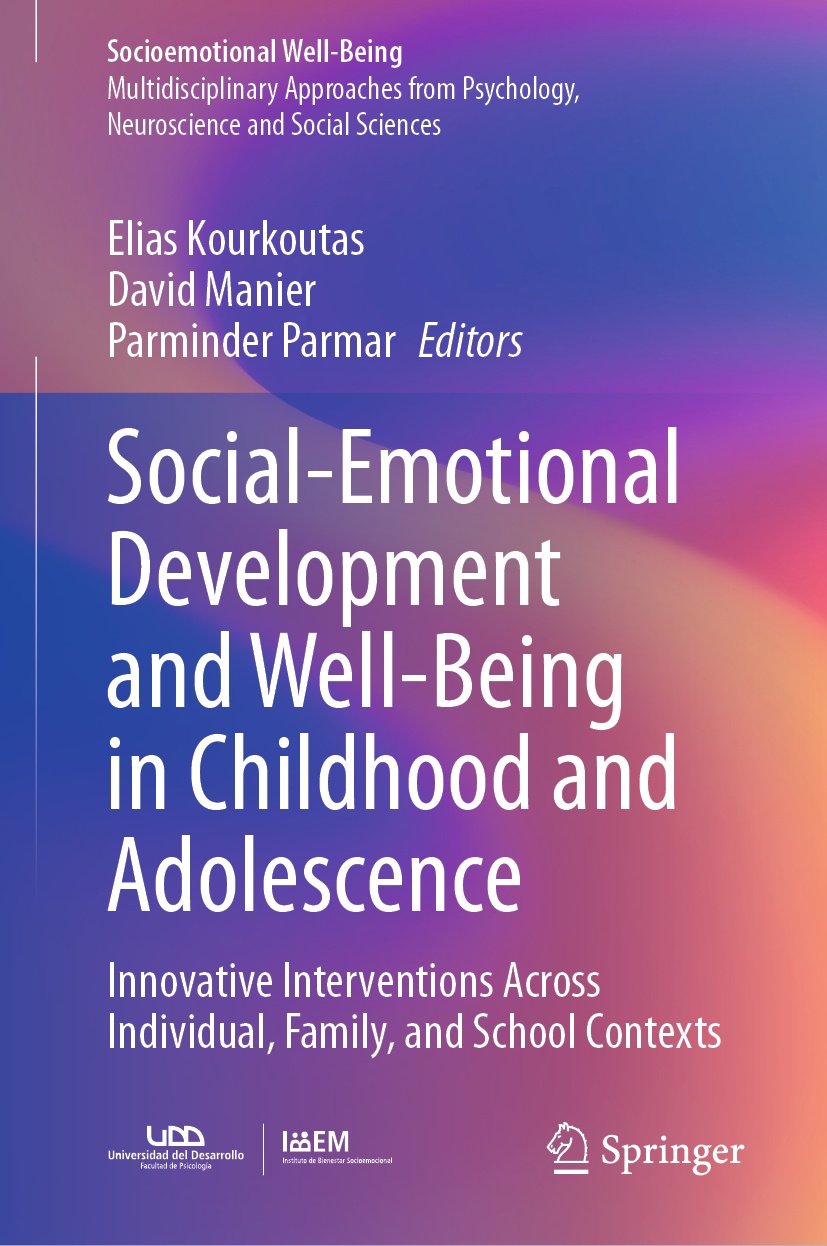
Social-Emotional Development and Well-Being in Childhood and Adolescence
Innovative Interventions Across Individual, Family, and School Contexts
Kourkoutas, Elias (Ed. / Hrsg.); Manier, David (Ed. / Hrsg.); Parmar, Parminder (Ed. / Hrsg.)
ISBN 978-3-032-33031-4 · Springer · XXX, 454 p. 16 illus., 9 illus. in color. ·
Description / Beschreibung
This book brings together interdisciplinary perspectives on the developmental, relational, and contextual processes shaping children’s and adolescents’ mental health and well-being. The volume situates social-emotional development within complex ecological systems, emphasizing the interplay between individual characteristics, family dynamics, school environments, and broader socio-cultural conditions.
Structured across three parts, the book first advances integrative theoretical frameworks, including attachment theory, interpersonal acceptance–rejection theory, relational developmental systems, self-determination theory, and psychodynamic and resilience-based approaches. It then examines family processes and parenting practices—including neurocognitive, motivational, and digital-era influences—highlighting their role in shaping emotional regulation, social functioning, and developmental trajectories. Finally, it presents evidence-informed interventions in educational and community contexts, addressing social and emotional learning (SEL), inclusive education, trauma-informed practice, mindfulness, arts-based approaches, and teacher well-being.
Combining research syntheses, conceptual analyses, and practice-oriented case material, the contributions emphasize non-pathologizing, strength-based approaches to resilience and psychosocial adjustment. The volume foregrounds equity, inclusion, and relational safety, particularly for children facing adversity, marginalization, or special educational needs.
Social-Emotional Development and Well-Being in Childhood and Adolescence: Innovative Interventions Across Individual, Family, and School Contexts will be of interest to researchers and advanced students in developmental, educational, and clinical psychology, as well as practitioners in school psychology, counseling, social work, and teacher education seeking theoretically grounded and context-sensitive approaches to promoting well-being across developmental settings.
Contents / Inhaltsverzeichnis
Part 1 Social-Emotional Development and Well-Being in Childhood and Adolescence.- Chapter 1 A Comprehensive Conception of Social-Emotional Well-Being.- Chapter 2 Social–Emotional Development and Well-Being in Childhood and Adolescence: Risks, Threats, and Resilient Processes in Family and School Contexts.- Chapter 3 Human Flourishing on the Intersection of Attachment and Interpersonal Acceptance Rejection.- Chapter 4 Children Making Sense of the Socio-Emotional World: Scripts, Social Theory of Mind, Narrative, and Situational Irony.- Chapter 5 Inclusion, human rights, and assertiveness: contextual nourishment for quality lives and well-being for all.- Part 2 Children’s Well-Being and Families.- Chapter 6 Resilient Families, Resilient Children: How Family Environments Shape Children’s Socio-Emotional Well-Being.- Chapter 7 Emotion in Transmission: Neurocognitive Mechanisms, Environmental Sensitivity, and Family-Based Well-Being.- Chapter 8 Parents’ Psychological Needs, Parenting Behaviors, and Children’s Well-Being: Bright and Dark Spirals in Parenting.- Chapter 9 Parenting in the Digital Era: Challenges in Promoting Children’s Social-Emotional Learning and Well-Being in a Time-Pressured World.- Part 3 Promoting Resilience and Children’s Well-Being in Individual and School Contexts.- Chapter 10 Arts Integrated Instruction and Socioemotional Development in Young Children:
Evidence, Mechanisms, and a Potential Model.- Chapter 11 Innovative Approaches to Fostering Resilience and Well-Being in Children and Adolescents: Mindfulness and Other Interventions.- Chapter 12 The Motivational Cycles of Resilience: A Self-Determination Theory Perspective.- Chapter 13 Students with special educational needs: Assessing their participation and socio-emotional well-being.- Chapter 14 Pedagogical Approaches for Schools that Nurture the Development of Social-Emotional Skills and Well-being.- Chapter 15 Social and Emotional Learning in Schools: An Overview of Systematic Reviews.- Chapter 16 Growth and Flourishing through the “PTG-Kids: The Mindful Strengths Journey”: A School-Based Intervention for Children with Adverse Experiences.- Chapter 17 Developing Soft Skills Through SEL: Inclusive Pathways to Growth for Students with and without Learning Difficulties.- Chapter 18 A resilience- and systems-informed psychodynamic model to enhance socio-emotional stability and well-being in students with behavioral problems.- Chapter 19 Innovative Interventions for Restoring Social-Emotional Capacities and Well-Being in Traumatized or Victimized Children.- Chapter 20 Enhancing Teachers’ Wellbeing through Gamification: Evidence from the Teaching to Be project.- Chapter 21 Art-Based Interventions to Enhance Internal Potential, Relational Abilities, and Well-Being in Children with Diverse Difficulties or Disorders.- Chapter 22 The School and Classroom as a Holding and Containing Environment to Promote Social-Emotional Well-Being in Teachers and Students with and without Difficulties.- Chapter 23 Final Reflections on Social-Emotional Well-Being.
Contributors / Mitwirkende
Elias Kourkoutas is Full Professor of Child and Adolescent Disorders and Special Educational Needs at the University of Crete, where he leads the Laboratory of Psychology and postgraduate programs in special education. He has published extensively on developmental psychopathology, resilience, and school-based interventions, and serves as President of the International Society for Interpersonal Acceptance–Rejection. His work integrates clinical, psychoeducational, and systemic-psychodynamic perspectives.
David Manier is Professor of Psychology at the City University of New York (Lehman College) and a clinical psychologist trained at the University of Chicago, Harvard, and the New School. His research addresses mindfulness, memory, trauma, and sociocultural influences on well-being. He has long combined academic teaching with applied work on contemplative and resilience-oriented interventions.
Parminder Parmar is a scholar in human development at Penn State Scranton with over four decades of teaching and research experience. Her work focuses on early childhood development, parenting, play, and interpersonal acceptance–rejection across the lifespan. An award-winning educator and mentor, she has contributed widely to research on relational processes and socio-emotional development.
Features / Besonderheiten
Presents a comprehensive and integrative conceptualization of social-emotional well-being and related interventions Shifts from deficit-focused models to strength-based approaches in well-being promotion Adopts a broad perspective encompassing the child's experience in school, family and community