Description
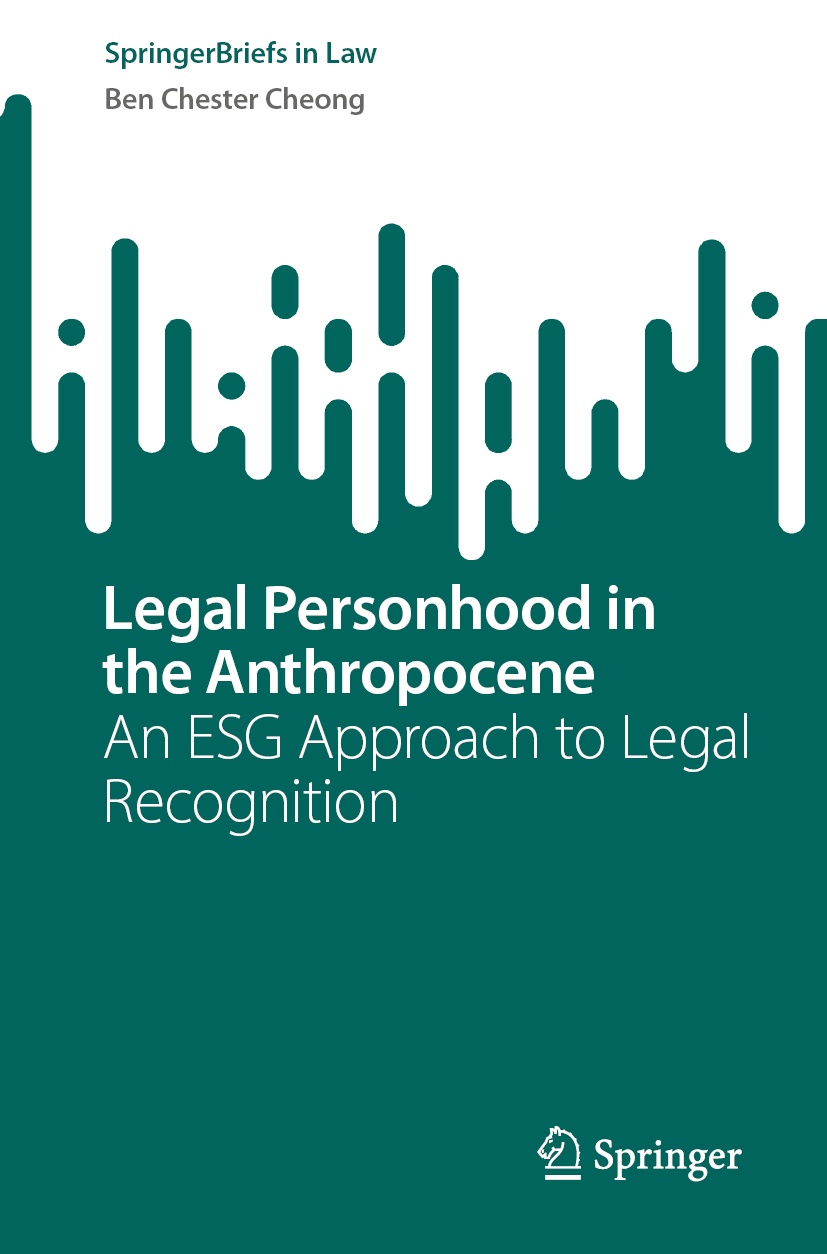
Legal Personhood in the Anthropocene
An ESG Approach to Legal Recognition
Cheong, Ben Chester
ISBN 978-3-032-41360-4 · Springer · XII, 126 p. 2 illus. ·
Description / Beschreibung
Legal personhood has expanded dramatically beyond traditional boundaries to include rivers, future generations, and potentially artificial intelligence and animals. Yet many such innovations fail, collapsing into symbolic gestures without practical effect. This book argues that these failures stem not only from fragmented approaches that privilege one dimension – environmental protection, governance efficiency, or social equity – while neglecting others, but also from treating legal personhood itself as a solution rather than as a regulatory tool requiring careful institutional design. Corporate personhood evolved through governance sophistication that often externalised environmental and social costs. Environmental personhood emerged from ecological imperatives but frequently faltered due to weak governance structures and contested legitimacy, as illustrated by contrasting New Zealand’s successful Whanganui River framework (comprehensive governance, dedicated funding, and Māori tikanga integration) with India’s failed river personhood orders (minimal resources, unclear authority, exclusionary framing). The book develops an integrated Environmental, Social, and Governance (ESG) framework establishing three interlocking criteria: environmental integrity, social equity, and governance feasibility. These function not as independent variables but as mutually constitutive requirements – environmental objectives require governance mechanisms and social legitimacy; governance arrangements require environmental purpose and social legitimation; social acceptance depends on environmental outcomes and governance processes. Through comparative analysis across multiple jurisdictions, the book shows how ESG can evaluate personhood regimes and, crucially, serve as a pre-recognition diagnostic for determining when governance should proceed through alternative legal architectures rather than through the creation of new legal persons. In doing so, it reframes personhood as an instrument of institutional design rather than a metaphysical status, offering practical guidance for judges, legislators, advocates, and administrators addressing environmental crisis, technological change, and evolving governance demands in the Anthropocene.
Contents / Inhaltsverzeichnis
Introduction.- Legal Personhood – Descriptive Foundations and the Normative Gap.- An Integrated ESG Framework for Evaluating Legal Personhood.- The Expanding Universe of Legal Persons – An ESG Analysis.- The Personhood Trap: Why ‘Recognition’ Often Fails as Regulation (and What ESG Is Actually For).- Conclusion – Integration as Foundation for Anthropocene Personhood.
Contributors / Mitwirkende
Dr Ben Chester Cheong is a Singaporean legal scholar whose work explores how law must adapt to profound changes in humanity’s relationship with nature, technology and future generations. A dual-qualified lawyer in Singapore and England & Wales, he is a Fellow at the Cambridge Centre for Environment, Energy and Natural Resource Governance (C-EENRG) based at the University of Cambridge, and Law Lecturer at the Singapore University of Social Sciences. He is an Associate Academic Fellow at the National University of Singapore Asia-Pacific Centre for Environmental Law (APCEL), and a Visiting Fellow at the University of Reading School of Law. He holds both a PhD and LLM from the University of Cambridge, and a LLB (First Class Honours) from the University of Exeter. He also placed 3rd out of 664 candidates, with 3 distinctions, in the 2016 Singapore Bar Examinations (Part B), and was the highest-ranking Cambridge law graduate of that cohort.
Features / Besonderheiten
Offers a holistic analysis of legal personhood, setting it apart from works that focus on a single aspect Draws upon case law from various jurisdictions, providing a global perspective on legal personhood Combines legal analysis with ethical and sustainability considerations