Description
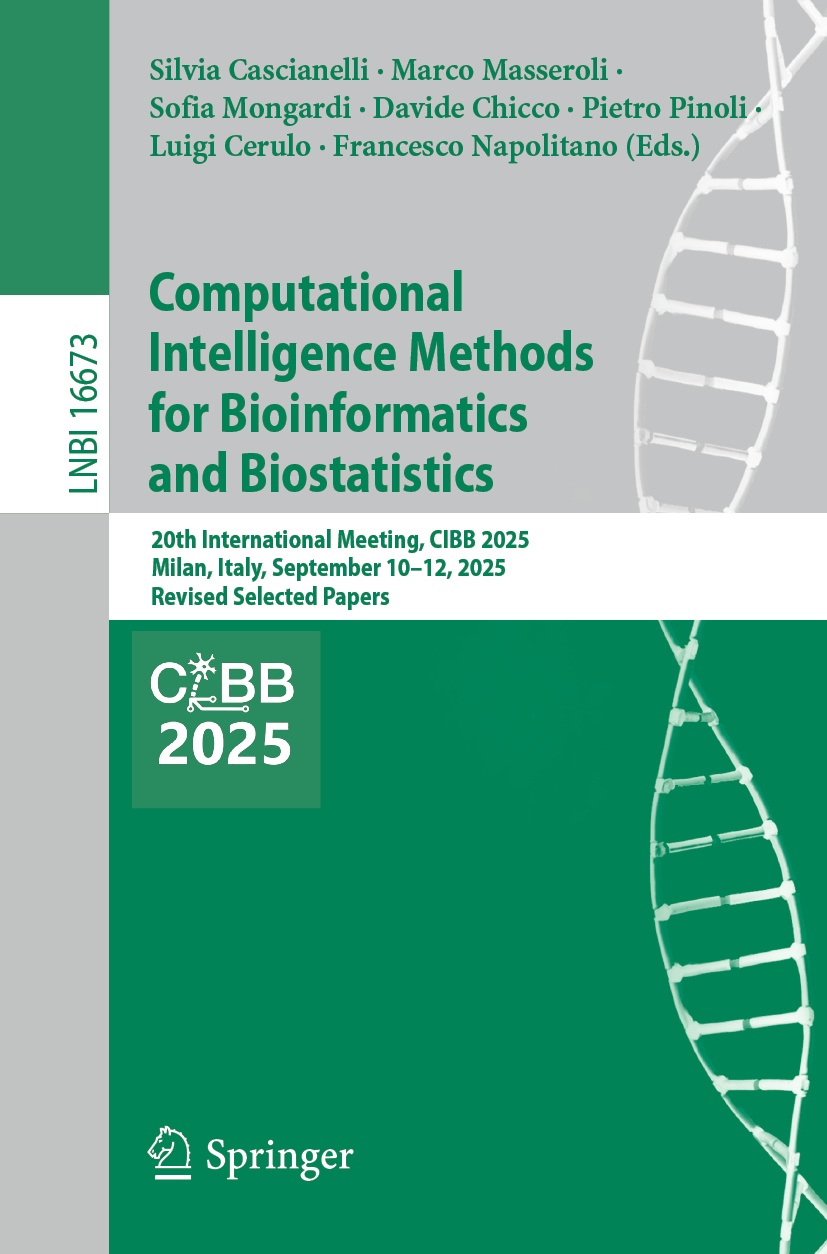
Computational Intelligence Methods for Bioinformatics and Biostatistics
20th International Meeting, CIBB 2025, Milan, Italy, September 10–12, 2025, Revised Selected Papers
Cascianelli, Silvia (Ed. / Hrsg.); Masseroli, Marco (Ed. / Hrsg.); Mongardi, Sofia (Ed. / Hrsg.); Chicco, Davide (Ed. / Hrsg.); Pinoli, Pietro (Ed. / Hrsg.); Cerulo, Luigi (Ed. / Hrsg.); Napolitano, Francesco (Ed. / Hrsg.)
ISBN 978-3-032-35063-3 · Springer · XII, 373 p. 50 illus., 30 illus. in color. ·
Description / Beschreibung
This Book constitutes the revised selected papers of the 20th International Meeting on Computational Intelligence Methods for Bioinformatics and Biostatistics, CIBB 2025, held in Milan, Italy, during September 10–12, 2025.
The 27 full papers presented were carefully reviewed and selected from 120 submissions. The conference focuses on emerging trends and future directions at the intersection of computational and life sciences, with particular interest in challenging problems in bioinformatics, biostatistics, and medical informatics. The full papers are organized in two sections: 'Bioinformatics and Network Modelling' and 'Machine Learning for Medical Informatics.
Contents / Inhaltsverzeichnis
.- Extending Autoencoders approaches for Binning Metagenomics Contigs.
.- Optimization of gene set collections for cancer transcriptomics using sparse principal component analysis.
.- Drug-Sensitivity Biomarkers Identification through a Network-Based Integration of mRNA and miRNA Data.
.- Sequence-to-expression prediction in synthetic biology using ezSTEP.
.- Cell Types classification of spatial proteomics data in normal human lymph nodes.
.- A Learning Algorithm for Threshold Boolean Networks with Prescribed Fixed Points.
.- Petri net model of glucose regulatory processes in the pancreas and the liver.
.- Prioritization of Influenza Type A virus genomes as possible recombinants.
.- UniBioEmbed: Heterogeneous Multi-Modal Knowledge Graph for Unified Biomedical Concept Embeddings.
.- Abstractions for RNA Secondary Structure Analysis.
.- A Differential Abundance Analysis Framework for the Indoor Microbiome in Asthma.
.- A network science-based computational approach to unveil the FMT-induced changes in the microbiota of enteropathic dogs.
.- RTimpu: Efficient Imputation for Left-Censored Missing Values in Metabolomics Studies.
.- Extending Generative Machine Learning for Sustainable Polymer Design: An Integrated Workflow from Generative Models to Bio-Based Candidates.
.- Interpretable Pancreatic Cancer Diagnosis Using Structured EUS Data and Machine Learning: A Multicenter Evaluation.
.- Classification of Bundle Branch Blocks from ECG Signals using Explainable Graph Neural Networks.
.- Decoding Visual Representations from BOLD fMRI Using Semantic Category-Specific Brain ROIs.
.- ARTInp: CBCT-to-CT with Gap Inpainting for Adaptive Radiation Therapy.
.- AdipoInsights: An Automated Framework for Large-scale Adipocyte Morphology Analysis.
.- TORTOISE: A Network Analysis Tool for Molecular Patient Clustering Based on Somatic Mutations.
.- Multimodal Machine Learning for Mixed Dementia Diagnosis: A Real-World Retrospective Study with Clinical and Imaging Integration.
.- Machine Learning for Predicting Continuous and Binary CFTR Modulator Response from Clinical and Microbiome Data.
.- Gen: Interpretable Multimodal Generation of Gene Expression Profiles Using Clinical and Imaging Data.
.- Explainable and Reliable Clinical Case Retrieval with RAG models.
.- Snakemaker applies generative AI for automatic translation of ad-hoc analyses into sustainable Snakemake workflows.
.- Exploring Uncertainty in Label-Free Brightfield Cell Image Detection with Deep Pretrained Neural Networks and Explainable AI.
.- Novel Knowledge-Guided Generative Methods for Synthetic Transcriptomic Data.